
 Treatments explained
Braces vs clear aligners: which is actually better?
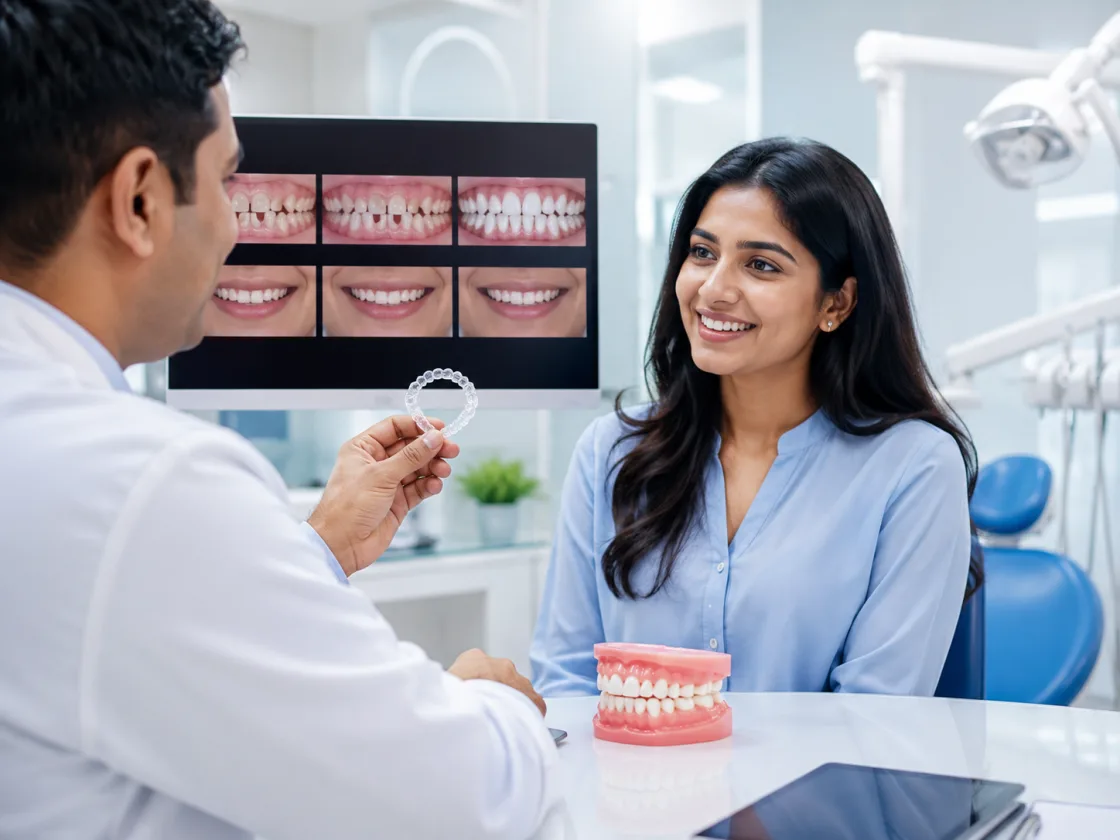
For mild to moderate crowding and spacing, both work and the choice is genuinely yours. For severe rotations, large extraction gaps or significant bite correction, fixed braces remain more predictable — and cost roughly a third as much.
Any clinic that recommends aligners for every case is selling, not diagnosing.
The honest comparison
- Cost — metal braces are the most economical, ceramic sits in the middle, clear aligners are the most expensive by some distance
- Treatment time — broadly similar, 12 to 24 months, though simple aligner cases can finish in 6 to 9 months
- Visibility — aligners are near-invisible; ceramic braces are discreet; metal braces are obvious
- Removable — aligners come out for eating and photographs; braces do not
- Complex movement — braces handle rotations, extraction-space closure and bite correction more predictably
- Depends on you — aligners only work while worn, 20 to 22 hours a day. Braces work whether you are disciplined or not
What aligners genuinely do better
Nothing gets trapped around a bracket, so hygiene is easier and the risk of white-spot decay marks is much lower. There are no emergency visits for a poking wire. And for adults in client-facing work, the appearance advantage is not vanity — it is the difference between having treatment and postponing it for another decade.
What braces genuinely do better
Braces apply continuous force to the whole tooth including the root. Aligners apply intermittent force mostly to the crown, which is why some movements — rotating a canine, uprighting a tipped molar, closing a premolar extraction space — are slower and less predictable with trays. Complex aligner cases often need attachments, elastics and mid-course re-scans that erode the convenience advantage.
How we decide at DentoXpert
- Full orthodontic records — OPG and lateral cephalogram X-rays, photographs and digital scans
- Assessment of whether the problem is dental crowding or a skeletal jaw discrepancy, because aligners cannot correct the latter
- A calculation of how much space is needed and whether extractions are required
- A recommendation with reasons, including cases where we advise braces even when the patient asked for aligners
Whichever you choose, retainers afterwards are not optional. Teeth drift for life. Every case we finish leaves with retainers and instructions to wear them nightly, indefinitely.
Book a free orthodontic assessment
We will tell you honestly which option suits your case.